
Table of Contents
Creamed potatoes are a dish that converts simple into rich comfort food on the side. Potatoes cooked properly land tender, soft and buttery — perfect to accompany nearly every main.
Great creamed potatoes start with the proper Creamed Potatoes properly cooked in salt water to breaking point and mashed to how you choose them. The tools you use also can play a role too, particularly if you want rustic (or silky smooth ) potatoes.
Common questions
What Are Creamed Potatoes?
Essentially, they are decorated mashed potatoes with a creamier add-in such as butter milk or even mayonnaise. They’re softer and more luxurious than standard mashed potatoes and can be adjusted from chunky rustic to downright silky.
You want Creamed Potatoes that will be cooked in the end evenly for any good recipe. Following boiling you want to drain those spuds very well before putting butter and heated dairy in. This helps them stay creamy with none of the wateriness that mashed potatoes can sometimes have.
The mashing method also matters. A classic masher will leave some texture, and a potato ricer will give ultra Creamed Potatoes. If you often cook with Creamed Potatoes, the correct kitchen utensil can facilitate preparation.
Ingredients for Creamed Potatoes
- For a simpler, family style recipe you could use:
- 2 pounds potatoes
- 4 tablespoons butter
- ½ to ¾ cup warm milk or cream
- 1 teaspoon salt
- ¼ teaspoon black pepper
- Optional garlic
- Optional fresh parsley
- Optional grated cheese
Use warm milk for extra Creamed Potatoes, rather than adding cold dairy directly onto hot Creamed Potatoes. Then, you can add as much butter and cream as you like for your desired consistency.
How to Make Creamed Potatoes
Prepare the Potatoes
If using peeled Creamed Potatoes, peel them and chop into evenly sized wedges. Uniform pieces do help some potatoes escape Creamed Potatoes mush and coming out hard as rock — it means they will all take about the same amount of time to cook.
Put the Creamed Potatoes in a pot and cover with cold water. It is seasoned with salt and you let the water come to a light simmer.
Cook Until Tender
Boil the Creamed Potatoes until fork tender. Potatoes that take on too much water during cooking will yield a loose or watery mash, so do not overcooking them.
Drain the Creamed Potatoes thoroughly. Allow them to rest briefly in the warm pot — excess water will evaporate.
Add Butter
Add butter while the Creamed Potatoes are hot. The heat will melt and coat the pieces of Creamed Potatoes evenly with butter.
For a more luxurious version, you can mix butter and cream. Begin with less liquid than needed and gradually increase the liquid quantity.
Mash to Your Preferred Texture
Now choose your preferred tool. If you prefer a slightly chunky result, a masher is great, but if you’re looking for completely smooth potatoes, then you may want to use a ricer.
Mash gently rather than aggressively. Over-mixing can tend to make Creamed Potatoes gluey and dense.
Add Warm Milk or Cream
Add warm milk or cream in small amounts while stirring. Repeat this until the potatoes are as you want them.
Check the seasoning with salt and pepper. You can even try adding salt, garlic, herbs, cheese or other spices for a more exciting flavor.
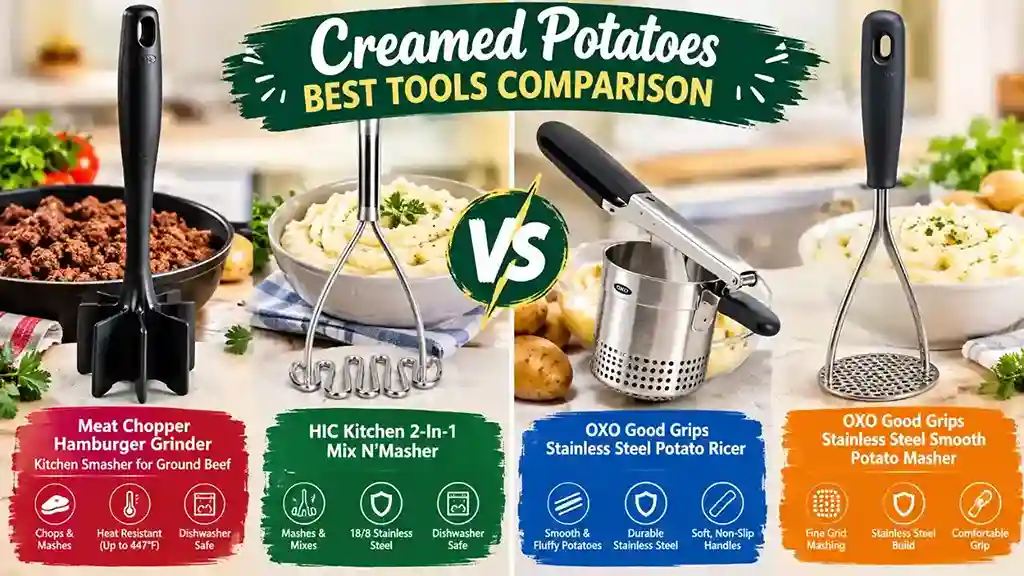
1. Meat Chopper Hamburger Grinder, Kitchen Smasher for Ground Beef
The Meat Chopper Hamburger Grinder mainly focuses on breaking up fillerOnce meat, this makes it ideal as the cutting edge is exceedingly wide, beveled, and adequately thick for mashing soft solid food. It can serve as a multipurpose tool depending on the recipe you are going to make for example when making creamed potatoes and you want to mash them right where they were cooked in a pot or bowl.
It has a set of 5 wide beveled blades to break and crumble food efficiently. Additionally the angled edge is great to help you scrape down the sides of pots when stirring. It features BPA-free nylon and is heat resistant up to 447°F although the directions say not to leave it in a hot pan for too long.
What it is: A multi-functional tool for the cook who wants just one utensil which serves several functions in the kitchen.
Key Feature: Five wide beveled blades, heat- resistant nylon.
Pros:
- Five-blade design
- Good for potatoes and ground meat
- Easy to clean
- Dishwasher safe
- Suitable for nonstick cookware
Cons:
- Not intended as a potato ricer specifically
- Not intended for frozen meat
- Avoid prolonged exposure inside the blazing hot cooking container.
- Suggested: For anyone who the needs a kitchen masher in multiple functions.
Best For: Ground meats & other soft foods like Creamed Potat

2. OXO Good Grips Stainless Steel Potato Ricer
Who it’s for: Cooks who want ultra smooth and fluffy potatoes. Why we chose the OXO Good Grips Stainless Steel Creamed Potato Ricer: A ricer works differently from a traditional masher: Rather than mashing your potatoes, the ricer pushes cooked potatoes through tiny holes to create fluffy small pieces.
The body is made from tough, durable stainless steel and insulated as well as soft while the handles are designed for easy handling. The nonslip knob can help you hold the ricer firmly above a bowl or pot, which may allow for increased control while preparing.
Value: Good option for making the perfect silky potatoes each time
CtopoGo Crock Pot Cooker With Glass Lid and Non-Stick Inner Nonslip Knob and Soft Handle
Key Feature: Material & Technology : Stainless Steel
Pros:
- Creates smooth, fluffy Creamed Potatoes
- Durable stainless steel construction
- Comfortable handles
- Dishwasher safe
- Great for carrots and cauliflower as well
Cons:
- Takes up more room than a simple masher
- Not as well if you seek chunky potatoes
- Requires an extra pressing step
Cook’s Note: For smooth, restaurant-style mashed potatoes.
Ideal For: Creamed potatoes, cauliflower, carrots, yams and also baby food

3. OXO Good Grips Stainless Steel Smooth Potato Masher
For cooks looking to achieve a smooth potato without engaging in the tedium of using a ricer, there’s the OXO Good Grips Stainless Steel Smooth Potato Masher. The fine grid patterns aid in breaking up cooked potatoes and root veggies while maintaining control over the final texture.
A softer grip, the broad handle is designed for easy squeezing and application of pressure during prep. And with its nigged, stainless steel structure it can also make for a great piece in a normal kitchen utensil collection.
Value: A simple tool for making mashed Creamed Potatoes daily.
Key Feature: High grade fine mash grid for a smooth outcome.
Pros:
- Fine mashing pattern
- Stainless steel construction
- Comfortable nonslip handle
- Dishwasher safe
- BPA free
Cons:
- Can require some hand pressure
- Less silky than a ricer
- Avoid making a very large batches of food at the same time
SEE ALSO: The Best Way to Make Creamy Mashed Potatoes for a Crowd
Optimal For: Potatoes, root vegetables, fruits and soft foods.

4. HIC Kitchen 2-In-1 Mix N’Masher Potato Masher
HIC Kitchen 2-In-1 Mix N’Masher a seating MX3 can be of mashing and mixing in this utensil it uses stainless steel. Because it is for Creamed Potatoes, vegetables, fruits (except soft fruit), eggs, guacamole and sauces and dishes with creamy consistency this tool reaches all areas of everyday cooking.
It is made of 18/8 stainless steel, durable and rustproof. The side wires can aid in scraping food away from the sides of bowls and pots, cutting down on waste as you prepare. The one-piece design also eliminates crevices where food might gather easily.
Value: Versatile tool for mashing and mixing.
Important: 2-in-1 stainless steel, mashing and mixing design.
Pros:
- Durable 18/8 stainless steel
- Multipurpose design
- Dishwasher safe
- Easy to store
- Useful for many soft foods
Cons:
- Curries well and can leave more texture than a ricer
- When it comes to Wire design, there may be a necessity to have appropriate methodologies
- Not as specialized as a specific potato ricer
Best For: Daily prep work in the kitchen.
Best Suited For: Potatoes, other vegies, fruits, eggs and also guacamole in addition to baby food.

ALSO READ:Orange Roughy Recipe Fish Dinner 2026
Creamed Potato Cooking Tips
Use the Right Potatoes
Fluffiest easily mashed Creamed Potatoes straigh from godfordoved take grount. Yukon Gold potatoes offer a naturally buttery consistency, while russet potatoes yield an airy mash with less starch.
Warm Your Dairy
Warm milk or cream is incorporated into hot potatoes much easier than cold dairy. It allows the dish to keep an even temperature and finish the desired consistency.
Don’t Overwork the Potatoes
Too much mixing can turn mashed Creamed Potatoes into a gumy mess. Mashing the potatoes until they are as squashed/smooth as you want.
Season Gradually
Potato — So much better with salt! Incorporate little by little, tasting as you proceed.
Add butter before too much adding liquid
The potato is coated with butter for it gives richness. Next, gradually include milk or cream until you get the consistency you want.
Common Mistakes to Avoid
Adding insufficient water: Boiled Creamed Potatoes suck up excess water and become hard to create a mash.
Introducing milk straight from the fridge: Very cool dairy can actually chill the potatoes even more and lessen their capacity to blend.
Too much mashing: Mixed just too long, cream make turn into sticky.
Not seasoning potatoes properly: Potatoes without sufficient salt are missing the actual nature of potatoes.
Adding all that cream in one go: You will have a much better control over the consistency with gradual additions.
Serving Ideas
Creamed potatoes serve as a great side dish to roast chicken, turkey, beef, pork cutlets and meatloaf and vegetables. They also serve as an excellent gravy tool, with a creamy consistency that is the ultimate base for flavorful sauces.
It goes great with a holiday meal serving them along side roasted turkey, stuffing, green beans and gravy. Serve them alongside grilled chicken or roasted vegetables for a quick and easy weeknight meal.
We also add roasted garlic, chives, parsley, black pepper or some cheese for another flavor profile.
Product Comparison
- Product
- Main Function
- Texture
- Material
- Best Use
- Meat Chopper
- Chop & mash
- Medium
- Nylon
- Multipurpose cooking
- OXO Potato Ricer
- Rice potatoes
- Very smooth
- Stainless steel
- Fluffy potatoes
- OXO Smooth Masher
- Mash potatoes
- Smooth
- Stainless steel
- Creamy potatoes
- HIC 2-in-1 Masher
- Mash & mix
- Adjustable
- 18/8 stainless steel
- Everyday cooking
Which Tool Should You Choose?
OXO potato ricer: If extreme smooth creamed potatoes is your end game, the OXO potato ricer is about as good as it gets for you. The pressing movement creates a creamy potato consistency before you add butter and cream.
If you like the old-school method, the OXO Smooth Potato Masher yields an easy-tocontrol texture by hand.
HIC Kitchen 2-In-1: This is very helpful in areas where versatility needs massive assistance, able to mash and mix multiple soft mains. For cooks who seek a multipurpose utensil that can handle both cooked ground meat and soft edible, the Meat Chopper comes in handy.
Conclusion
Creamed potatoes made in your home do not require fancy ingredients. The four key processes include: cooking the potatoes until tender, draining them well, adding butter and a small amount of warm dairy slowly, and mixing sparingly.
Having a proper kitchen tool to learn and navigate through the process is also easier. An interior ricer is fantastic for unprecedentedly smooth finish, and profound crushers gives more power per bite. Multipurpose tools can be useful for chefs who desire one tool to handle several tasks.
FACTURE QUESTION
Using your fingers, mash the garlic and potatoes through a ricer into a saucepan (<1/2 inches of water) to create an even consistency.
Cook potatoes until tender then drain well before mashing with butter and slowly adding warmed milk or cream. Adjust the consistency by adding more or less liquid, and season with salt and pepper.
What makes creamed potatoes creamy?
Fat from butter and warm milk or cream give richness, moisture. Cooked right and lightly mashed they will turn creamy.
Milk or cream for creamed potatoes?
Both can work. While milk yields a lighter result, cream creates a more decadent thicker result. You can also mix together milk and cream.
COULD YOU MAKE CREAMED POTATOES WITHOUT A RICER?
Yes. A good old potato masher is what works the best. When you’re looking for an especially smooth texture, a ricer is just one more choice.
Why do I have gummy cream potatoes?
Dependent on the manner in which potatoes are worked or combined, learn how that can cause them to become gummy. Mash lightly and stop when the desired consistency is achieved.
Can I make creamed potatoes ahead of time?
Yes. You can make them ahead of time and store them in a covered container in the refrigerator. When warming up if they are dry, add a little milk, cream or butter.
What kind of potatoes are best for creamy mashed potatoes?
Good options are russet and Yukon Gold potatoes. Russets can make for a fluffy texture, while Yukon Gold potatoes will give a rich and buttery flavor — all in their natural form.
Can you use garlic in creamed potatoes?
Yes. Roast or Cooked Garlic provides umami flavors. Stir it into the potatoes with the butter and dairy.
What to serve with creamed potatoes?
They go well with roast beef, chicken, turkey, pork, meatloaf and vegetables and gravy. These are particularly great idea to serve as a holiday meal side dish.


